4.5
4.5



 Història
  Agenda


 Llibreries


 Inici
Inici 


Detalls del llibre
1. Overview of the wave generation process and the wave field. 1. Explosion parameters -- 2. Overview of the initial conditions -- 3. Cavity formation -- 4. Upper and lower critical depths -- 5. The compressible hydrodynamic phase -- 6. The incompressible hydrodynamic phase -- 7. The potential flow approach -- 8. The prevailing theoretical approaches -- 9. Brief historical review of past investigations -- 10. Main physical features of EGWWs as seen through the linear wave theory -- 11. Data sources and scaling -- 12. Propagation of EGWWs over nonuniform water depths -- 13. Dissipative processes by wave-seafloor interaction -- 14. Wave breaking and nearshore phenomena -- 15. The EGWW environment on continental shelves due to large yield explosion in deep water -- 16. Accuracy of results and research needs -- 17. Tactical, strategic, and operational implications -- 2. Linear theory of impulsively generated water waves on a horizontal bottom. 1. Derivation of a general mathematical model -- 2. Initial conditions -- 3. Integration by fourier transform -- 4. Overview of analytical and numerical solutions -- 5. Analytical solutions - The stationary phase approximation -- 6. Determination of the numerical initial disturbances -- 7. Analytical forms of initial disturbances, closed form solutions -- 8. The leading wave -- 9. Movement at or near GZ -- 10. Limits of validity -- 3. Calibration of the linear wave theory. 1. Review of past investigations - Empirical correlations -- 2. Generalized model based on inverse correlation -- 3. Simplified model -- 4. Calibration -- 5. Depth of burst (DOB) effect, postulation for subsurface explosions -- 6. Correlation of burst depth effect in the mathematical model -- 7. Wave making efficiency -- 8. Summary -- 4. Nonlinear wave generation mechanism and wave propagation in shallow water. 1. Physical overview and theoretical approach -- 2. Wave generation mechanism -- 3. Collapse of a cylindrical cavity on a dry bed - Governing equations -- 4. Application -- 5. Bore formation and propagation -- 6. Nonlinear wave propagation - Importance of nonlinearities -- 7. The Boussinesq equations in a cylindrical coordinate system -- 8. Transformation of the Boussinesq equations into KdV equations -- 9. Extended KdV equation -- 10. Modes of solutions and numerical procedures - The split-step fourier algorithm -- 11. Theoretical and experimental verification -- 5. Application of nonlinear theory and calibration. 1. Evolution from bore to nonlinear waves -- 2. Hydrodynamic energy dissipation and effect of lip shape -- 3. Calibration -- 4. Efficiency of shallow water explosions -- 5. Comparison between linear and nonlinear theories -- 6. Effect of water depth and depth of burst -- 6. Dissipative processes of wave propagation. 1. Importance of dissipative processes by wave-seafloor interaction -- 2. Conservation of energy flux -- 3. Turbulent boundary layer effects -- 4. Wave friction factor over a movable bed - Overview -- 5. Procedure for determining the wave friction factor for EGWWs -- 6. Response to wave-induced pressure fluctuations -- 7. Dissipation by wave breaking -- 7. Propagation of transient waves on nonuniform bathymetries. 1. Basic principles - A review -- 2. Evolution of a periodic wave from a point source over a 3D bathymetry -- 3. Transformation of a finite source from the wave number domain to the frequency domain -- 4. Analytical verifications on area source solutions -- 5. Simplified formulation -- 6. Propagation of EGWWs on a gentle slope -- 7. Experimental verifications of propagation on 3D bathymetries -- 8. Nonlinear shoaling -- 8. Laboratory simulation of EGWWs. 1. The need for scale model simulation -- 2. Scale model simulation of EGWWs by small charges -- 3. Generation of monochromatic waves at an angle by snake paddle -- 4. Generation of 3D transient waves by snake paddle -- 5. Experimental verification of the snake wave paddle generation -- 6. Generation of a transient wave with axisymmetry in a ID wave flume -- 7. The use of a plunger -- 8. Slamming of a falling plate on shallow water -- 9. Establishment of the equation of movement of a sinking plate -- 10. Analysis and results of a sinking plate -- 11. Experimental verification of the drop of a flat circular plate -- 12. Waves generated by the impulse of a falling plate -- 9. BIEM formulation of explosion bubble dynamics. 1. Introduction -- 2. Mathematical formulation -- 3. Numerical implementation -- 4. Method of solution -- 5. Simulation of bubble breaking -- 6. Parametric presentation -- 7. Equivalent-energy correlations -- 8. Summary
Llegir més - Autor/a WANG KANGSHEND
- ISBN13 9789810221324
- ISBN10 9810221320
- Pàgines 367
- Any Edició 1996
- Fecha de publicación 02/05/1996
- Idioma Alemany, Francès
Ressenyes i valoracions
Sigues la primera persona a valorar-lo!
Has llegit Water Waves Generated By Underwater Explosion?


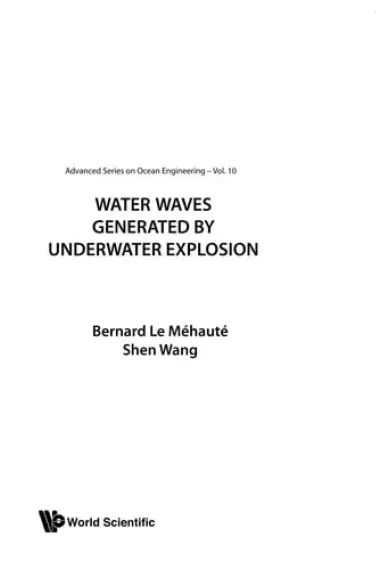
Water Waves Generated By Underwater Explosion (Alemany, Francès)
- De
- WANG KANGSHEND
- |
- World Scientific Publishing Company (1996)
- 9789810221324
72,86€
76,70€
-5%
Enviament Gratuït
No disponible
72,86€
76,70€
-5%
Enviament Gratuït
No disponible


Devolució gratuïta

 Gràcies per comprar a llibreries reals!
 Whatsapp
 Facebook
 Linkedin
 X
X