4.5
4.5



 Història
  Agenda


 Llibreries


 Inici
Inici 
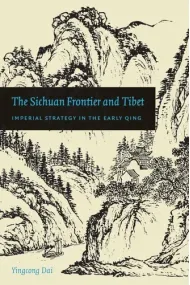


Detalls del llibre
Review"This excellent narrative proves that the dynamic process of imperial strategy exhibited on the Sichuan frontier and Tibet during the early Qing is critical to understanding the history of Qing as a whole, making this book an essential reading for all specialists."?Tianxiang Jiang, Journal of Chinese Military History, 1.2012"Dai's revisionist work forces us to reconsider two sacred tropes in Chinese history, the predominance of civilian over military values, and that Qing success rested on blind adherence to Chinese administrative norms."?Blaine Chiasson, Canadian Journal of History, Volume XLVI"Dai has provided us with a highly informative study of how state policies and military institutions shaped the socioeconomic reconstruction of eighteenth-century Sichuan . . . . [and] has provided us with a valuable study of how state policy and military institutions led to the dramatic reconstruction of Sichuan province during the eighteenth century."?John Herman, Pacific Affairs, June 2011"Provides a fresh explanation of Sichuan's place in the Qing system based on the empire's strategic endeavor in the Tibetan and Mongolian regions of Inner Asia."?Journal of Asian Studies"Dai's vivid study of Sichuan allows us to see in some detail the ways in which Qing expansion into Dzungharia and Tibet profoundly militarized the economies and the political elites of Sichuan, Gansu and Shaanxi, while nurturing the intertwining of mobilization and corruption that made the empire as incapable of containing rebellion in the heartland as it was further extending its conquests at the borders."?The China Quarterly"This is a wonderful, meticulously-documented and tersely written work on the Sichuan frontier and, more broadly, on Qing China's empire building in the Southwest. It is also a welcome addition to the exciting literature on the history of the Qing frontier."?Journal of the Royal Asiatic Society"This book is a brilliant study of the interplay between regional and central governments during a pivotal period as China expanded into Tibet and Xingjiang. Summing up: Essential."?Choice"? an opportunity for non-specialists interested in Tibet to understand the historical narrative and analytical context that informs domestic scholarly opinion on that region in China today."?American Historical Review, American Historical Review"Collecting and scrutinizing imperial archives in Taipei, Beijing, Chongqing, and even Paris, as well as in some major East Asian libraries in the United States, Dai successfully presents a solid and comprehensive study on a previously ignored region of the Qing Dynasty."?The Chinese Historical Review, The Chinese Historical Review"This pioneering work is a well?crafted narrative which shows the extensive local effects of central court decisions. Most important, it demonstrates clearly the fundamental importance of military institutions and policies for the formation of the empire."?Peter C. Perdue, Yale University"An excellent contribution to the field of Qing history. This is regional history at its best. Dai's study both engages and transcends local concerns, showing how regional histories are directly affected by national and international considerations."?Laura Hostetler, University of Illinois at ChicagoProduct DescriptionDuring China's last dynasty, the Qing (1644-1911), the empire's remote, bleak, and politically insignificant Southwest rose to become a strategically vital area. This study of the imperial government's handling of the southwestern frontier illuminates issues of considerable importance in Chinese history and foreign relations: Sichuan's rise as a key strategic area in relation to the complicated struggle between the Zunghar Mongols and China over Tibet, Sichuan's neighbor to the west, and consequent developments in governance and taxation of the area.Through analysis of government documents, gazetteers, and private accounts, Yingcong Dai explores the intersections of politi
Llegir més - Autor/a Russell (UCLA Dept. Of History) Jacoby
- ISBN13 9780295989518
- ISBN10 0295989513
- Pàgines 368
- Any Edició 2010
- Fecha de publicación 21/01/2010
- Idioma Alemany, Francès
Ressenyes i valoracions
Sigues la primera persona a valorar-lo!
Has llegit Sichuan Frontier and Tibet: Imperial Strategy in the Early Qing?



Sichuan Frontier and Tibet: Imperial Strategy in the Early Qing (Alemany, Francès)
- De
- Russell (UCLA Dept. Of History) Jacoby
- |
- University of Washington Press (2010)
- 9780295989518
133,33€
140,35€
-5%
Enviament Gratuït
No disponible
133,33€
140,35€
-5%
Enviament Gratuït
No disponible


Devolució gratuïta

 Gràcies per comprar a llibreries reals!

 Novetat

 Whatsapp
 Facebook
 Linkedin
 X
X