4.5
4.5



 Història
  Agenda


 Llibreries


 Inici
Inici 


Detalls del llibre
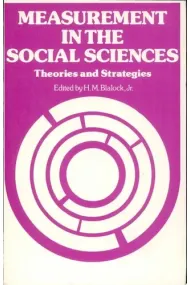
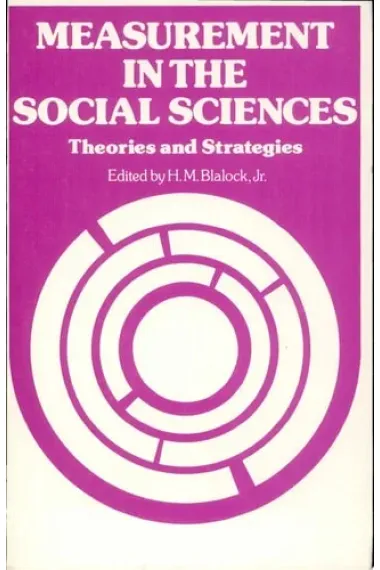
Among the frustrations constantly confronting the social scientist are those associated with the general process of measurement. The importance of good measurement has long been recognized in principle, but it has often been neglected in practice in many of the social sciences. Now that the methodological tools of multivariate analysis, simultaneous-equation estimation, and causal modeling are diffused more widely into the social sciences, and now that the very serious implications of random and non-random measurement errors are being systematically investigated, it is all the more important that social scientists give top priority to the quality of their data and the clarity of their theoretical conceptualizations, as well as to methods for analyzing fallible data.This book deals with selected problems of measurement and is written for graduate students and professional social scientists, particularly in the technically less developed fields of sociology, political science and anthropology. The book is organized so that, in general, one proceeds from problems of data collection to those of data analysis. It is not intended to be a complete work covering all types of measurement problems that have arisen in the social sciences. Instead, it represents a series of studies of topics that are deemed to be crucial for the advancement of social science research but which have not received sufficient attention in most of the social sciences. The basic purpose is to stimulate further methodological research on measurement and to study the ways in which knowledge that has been accumulated in some fields may be generalized so that it may be applied to others.The book is divided into three major parts. Part I is concerned with applying scaling approaches developed in psychometrics to problems that arise in other social sciences. The focus is on finding better ways to ask questions of respondents so as to raise the level of measurement above that of simple ordinal scales. Part II focuses on multiple-indicator theory and strategies as applied to relatively complex models and to change data. In this section the emphasis shifts to how one analyzes fallible data through the construction of explicit measurement-error models. Part III deals with the statistical analysis of ordinal data, including the interpretation and empirical behaviors of various ordinal measures of association. The final chapter (written by the editor) discusses how ordered-metric assumptions may be used to make more powerful predictions than those characterizing much of contemporary social science.H.M. Blalock, Jr. (1926-1991) was Professor, Department of Sociology, the University of Washington, Seattle. He was recipient of the 1973 ASA Samuel Stouffer Prize, and was a Fellow of the American Statistical Association and the American Academy of Arts and Sciences, and is a member of the National Academy of Sciences. He was the 70th president of the American Sociological Association.
- Autor/a Hubert M. Blalock
- ISBN13 9780202302720
- ISBN10 0202302725
- Pàgines 464
- Any Edició 1974
- Fecha de publicación 09/05/1974
- Idioma Alemany, Francès
Ressenyes i valoracions
Sigues la primera persona a valorar-lo!
Has llegit Measurement in the Social Sciences?


Measurement in the Social Sciences (Alemany, Francès)
- De
- Hubert M. Blalock
- 9780202302720


 Gràcies per comprar a llibreries reals!
 Novetat






 Whatsapp
 Facebook
 Linkedin
 X
X