4.5
4.5



 Història
  Agenda


 Llibreries


 Inici
Inici 


Detalls del llibre
"ÝFeraoun¨ passionately examines the human condition with all its flaws and nobility, yet he occasionally describes events with an eerie detachment. Since he was assassinated by a French terrorist group just three days before the cease-fire that ended the war, his account is especially poignant. An emotionally draining and important work."-"Booklist"" Feraoun' s painfully candid yet engaging journal of the French-Algerian War constitutes an unusually poignant record of one of Africa' s cruelest colonial conflicts and one of twentieth-century France' s darkest moments. "Journal, 1955- 1962" will surely supplant Frantz Fanon as the definitive text on French Algeria in particular and on colonialism in general." -- Julia Clancy-Smith, author of "Rebel and Saint: Muslim Notables, Populist Protest, Colonial Encounters (Algeria and Tunisia, 1800- 1904)," "[Feraoun] passionately examines the human condition with all its flaws and nobility, yet he occasionally describes events with an eerie detachment. Since he was assassinated by a French terrorist group just three days before the cease-fire that ended the war, his account is especially poignant. An emotionally draining and important work."-Booklist"As a chronicle of what the break meant when it was taking place on the village streets and in the countryside, in the homes of the people most directly affected by its endless cruelty, the journal that Feraoun kept, at the urging of his friend Robles, somewhat irregularly, from 1955 until 1961, is indispensable. It is also entirely without philosophical affectation, a profound and concrete commentary on issues that would arise again in the ''north-south'' crises in the following decades, of which the Algerian revolution was, on might say, the laboratory. After years of anti-colonial and post-colonial theory, Feraoun''s journal is truly refreshing to read. In its pages a genuinely free man reflects on relations of power between the conqueror and the conquered, on the place of intellectuals and teachers in a political war, on the effect of repression and resistance on families and neighbors, friends and communities. The simplicity with which Feraoun approached these terrible events was a literary strategy, a literary accomplishment--and proof that he had a better grasp of the meaning of his country''s history than did most commentators in Paris and elsewhere. Keeping his journal, moreover, was an act of courage: people where arrested and killed for less overt expressions of sympathy for the rebellion. . . . [Feraoun and Camus] both learned French with the simplicity and the clarity that characterize that language''s best prose: they are the kinds of writers who seem, when you first encounter them, easy to read, and turn out to be far more difficult to understand. They always say much more than you thought they said. This is, of course, one definition of classical literature; and bothCamus, who won the Nobel Prize for Literature in 1957, and Feraoun, who is probably the most widely-read French-language Algerian writer of the century (after Camus), were part of the French canon by the late 1950s. . . . Tersely and eloquently, Feraoun summed up in the pages of his journal the injustice of the colonial system, but unlike the Paris intellectuals he did not dwell upon it, preferring to keep notes on what actually happened to actual people with whom he was acquainted. . . . Feraoun''s journal became one of the most important books to emerge from the Algerian conflict. It is an essential human document, a real war book. . . . The Algerian war . . . remains an unavoidable reference point in the debate over the kind of world we will live in. And this debate was foreshadowed in Feraoun''s journal, as in the polemical writings of Camus and Amrouche. For this reason, the publication of this English translation of Feraoun''s Journal is very welcome."-New RepublicFeraouns painfully candid yet engaging journal of the French-Algerian War constitutes an unusually poignant record of one of Africas cruelest colonial conflicts and one of twentieth-century Frances darkest moments. Journal, 19551962 will surely supplant Frantz Fanon as the definitive text on French Algeria in particular and on colonialism in general.Julia Clancy-Smith, author of Rebel and Saint: Muslim Notables, Populist Protest, Colonial Encounters (Algeria and Tunisia, 18001904) -- Julia Clancy-Smith"Feraoun's painfully candid yet engaging journal of the French-Algerian War constitutes an unusually poignant record of one of Africa's cruelest colonial conflicts and one of twentieth-century France's darkest moments. "Journal, 1955-1962" will surely supplant Frantz Fanon as the definitive text on French Algeria in particular and on colonialism in general."--Julia Clancy-Smith, author of "Rebel and Saint: Muslim Notables, Populist Protest, Colonial Encounters (Algeria and Tunisia, 1800-1904)"--Julia Clancy-Smith
En 1954, l?Algérie française s?insurge et réclame son indépendance. Très vite, éclate la guerre, sanglante. Mouloud Feraoun couche ses impressions, ses peurs, son désespoir et sa colère dans le journal qui l?accompagna du début de la guerre jusqu?à la fin de sa vie en 1962. L?écrivain n?aura pas la joie de connaître son pays libre, il sera assassiné quatre jours avant la fin des affrontements.
Mouloud Feraoun est né en 1913 en Haute Kabylie. Il a enseigné plusieurs années en Algérie avant d'être nommé inspecteur des centres sociaux. Son ?uvre comprend, entre autres Le Fils du pauvre et La Terre et le sang qui a reçu en 1953 le prix du roman populiste. Mouloud Feraoun est mort assassiné à Alger en 1962, A quelques jours de la fin de la guerre d'Algérie.
James D. Le Sueur is an associate professor of history at the University of Nebraska-Lincoln. He is the editor of "The Decolonization Reader" and "The Decolonization Sourcebook" and the author of "Uncivil War: Intellectuals and Identity Politics during the Decolonization of Algeria," Second Edition (Nebraska 2005). He contributed new material to Ben Abro's "Assassination! July 14" and Henri Alleg's "The Question," both available in Bison Books editions. Mary Ellen Wolf is an associate professor of French at New Mexico State University and the author of "Eros under Glass: Psychoanalysis" and Mallarme's "Herodiade." Claude Fouillade is an associate professor of French at New Mexico State University.
- Autor/a Mouloud Feraoun
- ISBN13 9782757824917
- ISBN10 2757824910
- Pàgines 491
- Fecha de publicación 08/05/2026
- Idioma Francès
Ressenyes i valoracions
Sigues la primera persona a valorar-lo!
Has llegit Journal 1955-1962 (Points)?



 Novetat


 Gràcies per comprar a llibreries reals!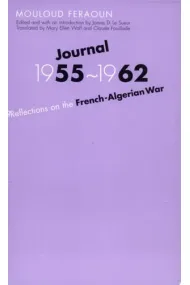
 Whatsapp
 Facebook
 Linkedin
 X
X