4.5
4.5



 Història
  Agenda


 Llibreries


 Inici
Inici 
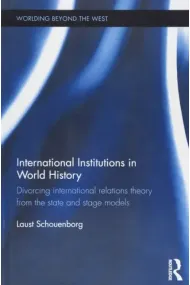


Detalls del llibre
This book presents a case for a basic reorientation of International Relations away from the state and towards the study of social institutions in the sense of patterned practices, ideas and norms/rules. IR has always suffered from a parochial occupation with the state and the Western system of state. Its main theories revolve around these phenomena, and have resulted in the reification of the state: it has been turned into an essential actor, with certain immutable and fundamental properties that remain constant throughout time. A list of these properties usually includes territorial limits, centralisation, monopolisation of violence and exclusive loyalties.
International Institutions in World History shows how the state is an inherently modern phenomenon, a modern social institution, and that foundational concepts in IR should be based on a full appreciation of the wider record of human existence on earth, trans-historically and cross-culturally. Schouenborg argues that these social institutions may be captured via a universal functional typology consisting of four categories: legitimacy and membership; regulating conflicts; trade; and governance.
The book will be of interest to scholars and students within IR (particularly IR theory), anthropology, archaeology and sociology, and those interested in general social theory.
- Autor/a Laust Schouenborg
- ISBN13 9781138221628
- ISBN10 1138221627
- Pàgines 175
- Any Edició 2026
- Fecha de publicación 14/05/2026
Ressenyes i valoracions
Sigues la primera persona a valorar-lo!
Has llegit International Institutions in World History Divorcing International Relations Theory from the State and Stage Models?


 Novetat
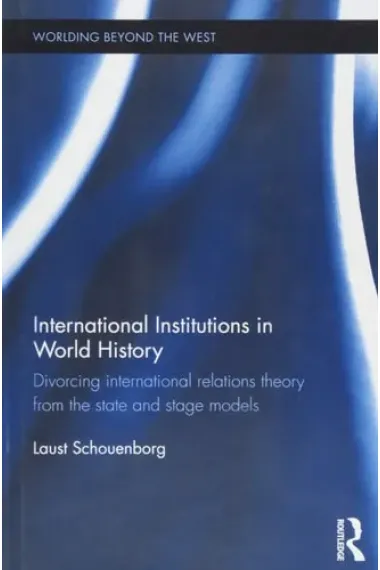
 International Institutions in World History Divorcing International Relations Theory from the State and Stage Models
- De
- Laust Schouenborg
- |
- ROUTLEDGE (2026)
- 9781138221628


 Gràcies per comprar a llibreries reals!
 Whatsapp
 Facebook
 Linkedin
 X
X