4.5
4.5



 Història
  Agenda


 Llibreries


 Inici
Inici 
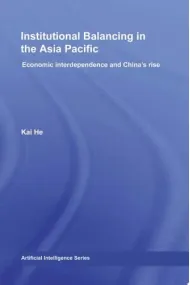


Detalls del llibre
This book examines the strategic interactions among China, the United States, Japan, and Southeast Asian States in the context of Chinaâ??s rise and globalization after the cold war. Engaging the mainstream theoretical debates in international relations, the author introduces a new theoretical frameworkâ??institutional realismâ??to explain the institutionalization of world politics in the Asia-Pacific after the cold war.
Institutional realism suggests that deepening economic interdependence creates a condition under which states are more likely to conduct a new balancing strategyâ??institutional balancing, i.e., countering pressures or threats through initiating, utilizing, and dominating multilateral institutionsâ??to pursue security under anarchy. To test the validity of institutional realism, Kai He examines the foreign policies of the U.S., Japan, the ASEAN states, and China toward four major multilateral institutions, Asia-Pacific Economic Cooperation (APEC), the Association of Southeast Asian Nations (ASEAN) Regional Forum (ARF), ASEAN Plus Three (APT), and East Asian Summit (EAS). Challenging the popular pessimistic view regarding Chinaâ??s rise, the book concludes that economic interdependence and structural constraints may well soften the "dragonâ??s teeth." Chinaâ??s rise does not mean a dark future for the region.
Institutional Balancing in the Asia Pacificwill be of great interest to policy makers and scholars of Asian security, international relations, Chinese foreign policy, and U.S. foreign policy.
- ISBN13 9780415469524
- ISBN10 041546952X
- Pàgines 209
- Any Edició 2026
- Fecha de publicación 06/05/2026
- Idioma Alemany, Francès
Ressenyes i valoracions
Sigues la primera persona a valorar-lo!
Has llegit Institutional Balancing in the Asia Pacific: Economic interdependence and China's rise?



 Novetat
 Institutional Balancing in the Asia Pacific: Economic interdependence and China's rise (Alemany, Francès)
- De
- 9780415469524


 Gràcies per comprar a llibreries reals!
 Whatsapp
 Facebook
 Linkedin
 X
X