4.5
4.5



 Història
  Agenda


 Llibreries


 Inici
Inici 


Detalls del llibre
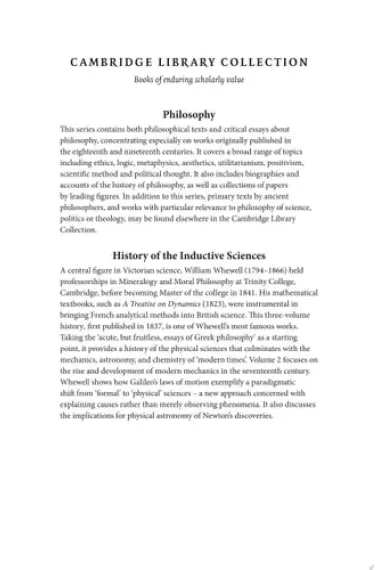
A central figure in Victorian science, William Whewell (1794-1866) held professorships in Mineralogy and Moral Philosophy at Trinity College, Cambridge, before becoming Master of the college in 1841. His mathematical textbooks, such as A Treatise on Dynamics (1823), were instrumental in bringing French analytical methods into British science. This three-volume history, first published in 1837, is one of Whewell's most famous works. Taking the 'acute, but fruitless, essays of Greek philosophy' as a starting point, it provides a history of the physical sciences that culminates with the mechanics, astronomy, and chemistry of 'modern times'. Volume 2 focuses on the rise and development of modern mechanics in the seventeenth century. Whewell shows how Galileo's laws of motion exemplify a paradigmatic shift from 'formal' to 'physical' sciences - a new approach concerned with explaining causes rather than merely observing phenomena. It also discusses the implications for physical astronomy of Newton's discoveries.
Llegir més - Autor/a William Whewell
- ISBN13 9781108019255
- ISBN10 1108019250
- Pàgines 552
- Any Edició 2010
- Fecha de publicación 09/09/2010
- Idioma Alemany, Francès
Ressenyes i valoracions
Sigues la primera persona a valorar-lo!
Has llegit History of the Inductive Sciences: From the Earliest to the Present Times?


History of the Inductive Sciences: From the Earliest to the Present Times (Alemany, Francès)
- De
- William Whewell
- |
- Cambridge University Press (2010)
- 9781108019255
56,81€
59,80€
-5%
Enviament Gratuït
Esgotat
56,81€
59,80€
-5%
Enviament Gratuït
Esgotat


Devolució gratuïta

 Gràcies per comprar a llibreries reals!


 Whatsapp
 Facebook
 Linkedin
 X
X