4.5
4.5



 Història
  Agenda


 Llibreries


 Inici
Inici 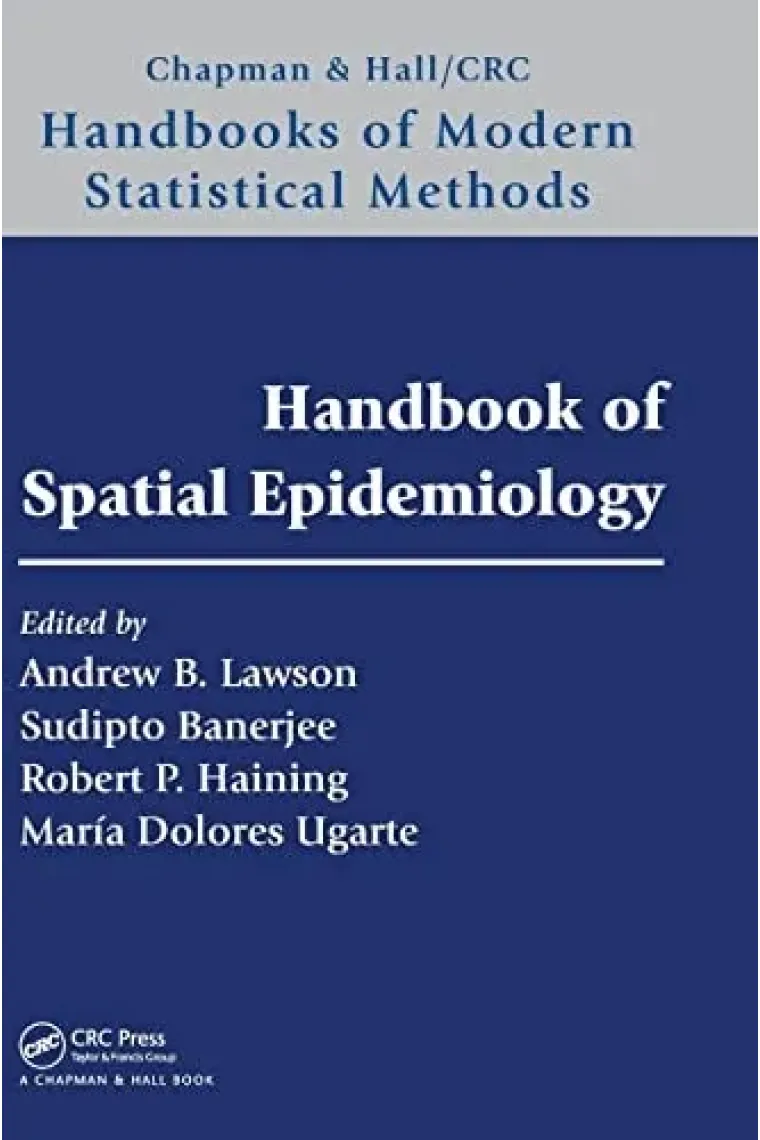


Detalls del llibre
Handbook of Spatial Epidemiology explains how to model epidemiological problems and improve inference about disease etiology from a geographical perspective. Top epidemiologists, geographers, and statisticians share interdisciplinary viewpoints on analyzing spatial data and space-time variations in disease incidences. These analyses can provide important information that leads to better decision making in public health.
The first part of the book addresses general issues related to epidemiology, GIS, environmental studies, clustering, and ecological analysis. The second part presents basic statistical methods used in spatial epidemiology, including fundamental likelihood principles, Bayesian methods, and testing and nonparametric approaches. With a focus on special methods, the third part describes geostatistical models, splines, quantile regression, focused clustering, mixtures, multivariate methods, and much more. The final part examines special problems and application areas, such as residential history analysis, segregation, health services research, health surveys, infectious disease, veterinary topics, and health surveillance and clustering.
Spatial epidemiology, also known as disease mapping, studies the geographical or spatial distribution of health outcomes. This handbook offers a wide-ranging overview of state-of-the-art approaches to determine the relationships between health and various risk factors, empowering researchers and policy makers to tackle public health problems.
- Autors Andrew B. Lawson, Sudipto Banerjee, Robert P. Haining, María Dolores Ugarte Martínez
- ISBN13 9781482253016
- ISBN10 1482253011
- Pàgines 684
- Any Edició 2026
- Fecha de publicación 12/05/2026
Ressenyes i valoracions
Sigues la primera persona a valorar-lo!
Has llegit Handbook of Spatial Epidemiology?


 Novetat
 Handbook of Spatial Epidemiology
- De
- Andrew B. Lawson, Sudipto Banerjee, Robert P. Haining, María Dolores Ugarte Martínez
- |
- Apple Academic Press (2026)
- 9781482253016


 Gràcies per comprar a llibreries reals!





 Whatsapp
 Facebook
 Linkedin
 X
X