4.5
4.5



 Història
  Agenda


 Llibreries


 Inici
Inici 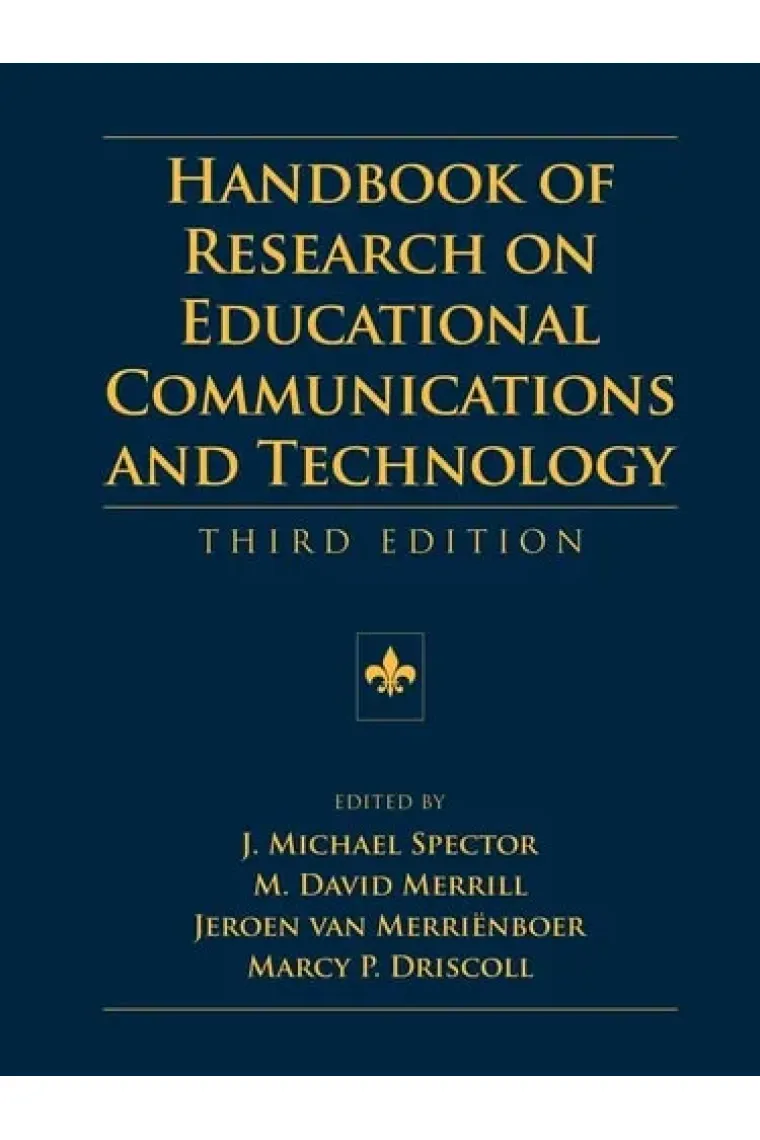


Detalls del llibre
TABLE OF CONTENTS Foreword Joost Lowyck vii Preface J. Michael Spector, M. David Merrill, Jeroen van Merri?nboer and Marcy P. Driscoll xvi Acknowledgements xxiii Contributors xxiv PART I: FOUNDATIONS Marcy P. Driscoll 1 1: Historical Foundations Michael Molenda 3 2: Theoretical Foundations J. Michael Spector 61 3: Complexity Theory Xiaopeng Ni and Robert Maribe Branch 89 4: Experiential Perspectives Konrad Morgan 101 5: Empirical Perspectives on Memory and Motivation Norbert M. Seel 117 6: Contextualistic Perspectives Eric J. Fox 171 7: Philosophical Perspectives Kathy L. Schuh and Sasha A. Barab 213 PART II: STRATEGIES M. David Merrill 265 8: Representation Strategies Linda L. Lohr and James E. Gall 267 9: Strategies for Designing Embodied Curriculum Sasha A. Barab and Tyler Dodge 301 10: Generative Learning: Principles and Implications for Making Meaning Barbara L. Grabowski, Hyeon Woo Lee, and Kyu Yon Lim 349 11: Feedback Strategies for Interactive Learning Tasks Susanne Narciss 383 12: Technology-Enhanced Support Strategies for Inquiry Learning Yael Kali and Marcia C. Linn 445 13: A Distributive Perspective for Collaborative Activity Tom Satwicz and Reed Stevens 491 14: Prescriptive Principles for Instructional Design M. David Merrill, Matthew Barclay and Andrew van Schaack 523 PART III: TECHNOLOGIES J. Michael Spector 557 15: Programmed Technologies Barbara B. Lockee, Miriam B. Larson, John K. Burton, and D. Michael Moore 559 16: Educational Hypertext Dale S. Niederhauser 589 17: Computer-Mediated Technologies Arthur C. Graesser, Patrick Chipman, and Brandon G. King 629 18: Computer-Mediated Communications Technologies Jay Pfaffman 679 19: K-12 Library Media Centers Delia Neuman 703 20: Technology-Based Knowledge Systems Ian Douglas 729 21: Flexible Learning and Learning Places Peter Goodyear 759 22: Enabling Time and Place Independence Som Naidu 781 23: Blended Learning Environments Charles R. Graham and Charles Dziuban 815 24: Adaptive Technologies Valerie J. Shute and Diego Zapata-Rivera 841 25: Generational Differences Thomas C. Reeves and Eun Jung Oh 897 26: Technologies Linking Learning, Cognition and Instruction Sabine Graf and Kinshuk 925 27: Synthetic Learning Environments Janis A. Cannon-Bowers and Clint A. Bowers 957 28: Modeling Technologies Roy B. Clariana and Johannes Strobel 997 29: The Learning Objects Literature David A. Wiley 1047 30: Open Source and Open Standards Rob Koper 1079 PART IV: MODELS Jeroen van Merri?nboer 1115 31: Human Cognitive Architecture John Sweller 1117 32: Outcome-Referenced, Conditions-Based Theories and Models Tillman J. Ragan, Patricia L. Smith and L.K. Curda 1161 33: Cooperation and the Use of Technology David W. Johnson and Roger T. Johnson 1221 34: The Cognitive Apprenticeship Model in Educational Practice Vanessa P. Dennen and Kerry J. Burner 1303 35: Whole-Task Models in Education Jeroen J.G. van Merri?nboer and Liesbeth Kester 1355 36: Model Facilitated Learning Ton de Jong and Wouter R. van Joolingen 1409 37: Adaptive Instructional Systems Jung Lee and Ok-Choon Park 1447 38: Problem-Based Learning Woei Hung, David H. Jonassen and Rude Liu 1503 39: Behavioral, Cognitive and Technological Approaches to Performance Improvement Ruth Colvin Clark and Frank Nguyen 1581 40: Resource-Based Learning Michael J. Hannafin and Janette R. Hill 1633 41: Instructional Models in Domains and Professions Henny P.A. Boshuizen, Caroline Phythian-Sence, Richard K. Wagner, Koeno Gravemeijer, Geerdina Maria van der Aalsvoort, Fleurie Nievelstein, Tamara van Gog, Frans J. Prins, Tim Dornan, Albert Scherpbier, and John Spencer 1673 PART V: DESIGN AND DEVELOPMENT M. David Merrill 1775 42: Competencies for the New-Age Instructional Designer Roderick C. Sims and Tiffany A. Koszalka 1777 43: Cognitive Task Analysis Richard E. Clark, David F. Feldon, Jeroen van Merri?nboer, Kenneth A. Yates, and Sean Early 1801 44: Design and Validation of Technology-Based Performance Assessments Eva L. Baker, Gregory K.W.K. Chung, and Girlie C. Delacruz 1857 45: Models and Methods for Evaluation Ron Owston 1893 46: Change Agentry Brian Beabout and Alison A. Carr-Chellman 1933 47: Design Languages Andrew S. Gibbons, Luca Botturi, Eddy Boot, and Jon Nelson 1979 48: The Social Consequences of Design and Development Teams Laura Blasi, Stephen M. Fiore, John Hedberg, and Richard F. Schmid 2021 49: User-Centered Design and Development Eun-Ok Baek, Kursat Cagiltay, Elizabeth Boling, and Theodore Frick 2063 50: Tools for Design and Development of Online Instruction Bryan L. Chapman 2103 51: Artifacts as Tools in the Design Process Elizabeth Boling and Kennon M. Smith 2141 52: Systems Design for Change in Education and Training Sunnie Lee Watson, William R. Watson, and Charles M. Reigeluth 2161 PART VI: METHODOLOGICAL ISSUES Jeroen van Merri?nboer 2193 53: Theory Development Jan Elen and Geraldine Clarebout 2195 54: Research Designs Steven M. Ross, Gary R. Morrison, Robert Hannafin, Michael Young, Jan van den Akker, Wilmad Kuiper, Rita C. Richey, and James D. Klein 2227 55: Data Collection and Analysis Tamara van Gog, Fred Paas, Wilhemina Savenye, Rhonda Robinson, Mary Niemczyk, Robert Atkinson, Tristan E. Johnson, Debra L. O?Connor, Remy M.J.P. Rikers, Paul Ayres, Aaron R. Duly, Paul Ward, and Peter A. Hancock 2385 56: Foundations for the Future ChanMin Kim, JungMi Lee, Jeroen van Merri?nboer, M. David Merrill, and J. Michael Spector 2443 Glossary of Terms 2473 Index of Authors Subject Index.
Llegir més - ISBN13 9780415963381
- ISBN10 0415963389
- Pàgines 894
- Any Edició 2026
- Fecha de publicación 05/05/2026
- Idioma Alemany, Francès
Ressenyes i valoracions
Sigues la primera persona a valorar-lo!
Has llegit Handbook of Research on Educational Communications and Technology?



 Novetat
 Handbook of Research on Educational Communications and Technology (Alemany, Francès)
- De
- |
- L. Erlbaum Associates (2026)
- 9780415963381
179,07€
188,50€
-5%
Enviament Gratuït
Esgotat
179,07€
188,50€
-5%
Enviament Gratuït
Esgotat


Devolució gratuïta

 Gràcies per comprar a llibreries reals!
 Whatsapp
 Facebook
 Linkedin
 X
X