4.5
4.5



 Geschichte
  Terminkalender


 Buchhandlungen


 Anfang


Buch Details
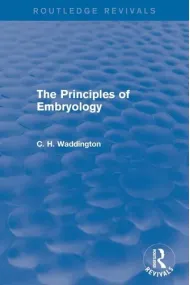
Cover -- Half Title -- Title Page -- Copyright Page -- Original Title Page -- Original Copyright Page -- Preface -- Table of Contents -- Part One The Facts of Development -- I. The Science of Embryology -- 1. The place of embryology among the biological sciences -- 2. An outline of development -- 3. Phylogenetic theories of embryology -- 4. The mechanisms of development -- Appendix. The concept of embryonic fields -- II. The Gametes -- 1. Spermatogenesis -- 2. Oogenesis -- 3. Follicles and membranes -- 4. The morphogenetic structure of the egg -- III. Fertilisation -- 1. Activation -- 2. The union of the nuclei -- 3. Artificial parthenogenesis -- IV. Cleavage -- 1. General features -- 2. The pattern of cleavage and the pattern of the embryo -- 3. Differentiation without cleavage -- 4. Cleavage without nuclei -- 5. The mechanism of cleavage -- V. The Echinoderms -- 1. Normal development -- 2. The gradient system -- 3. The dorso-ventral axis -- VI. Spirally Cleaving Eggs -- VII. The ascidians and Amphioxus -- VIII. The Insects -- 1. Embryonic development -- 2. Experimental analysis of some types of insect development -- 3. The transformation into the adult -- 4. The determination of imaginal characters -- IX. The Vertebrates: Amphibia and Birds -- 1. From the unfertilised egg to the formation of the blastula -- a. Amphibia -- b. Birds -- 2. Gastrulation: presumptive maps -- 3. The gastrulation movements -- a. Amphibia -- b. Birds -- 4. General properties of the gastrulation movements -- X. The Epigenetics of the Embryonic Axis -- 1. Amphibia -- 2. Birds -- 3. Evocation and individuation -- 4. The physiology of organiser action -- 5. What occurs during evocation? -- 6. Regionally specific evocation -- 7. Competence -- XI. Embryo Formation in Other Groups of Vertebrates -- 1. Cyclostomes and other primitive fish -- 2. Teleosts -- 3. Reptiles
Lesen Sie mehr - Autor/in C. H. Waddington
- ISBN13 9781138956988
- ISBN10 1138956988
- Buchseiten 510
- Jahr der Ausgabe 2016
- Fecha de publicación 08/04/2016
Rezensionen und Bewertungen
Sei die erste Person, die es bewertet!
Hast du gelesen The Principles of Embryology?



The Principles of Embryology
- Von
- C. H. Waddington
- |
- ROUTLEDGE (2016)
- 9781138956988
314,45€
331,00€
-5%
Sendung Kostenlos
Ausverkauft
314,45€
331,00€
-5%
Sendung Kostenlos
Ausverkauft


Kostenlose Rücksendung

 Vielen Dank für Ihren Einkauf in echten Buchhandlungen!
 Neuheit









 Whatsapp
 Facebook
 Linkedin
 X
X